Bolt Torque and Preload Analysis
Determine the required tightening torque for a bolted connection using the torque-tension relationship. Evaluates bolt preload capacity, applied clamping force, and bolt stress against proof strength.
About This Calculator
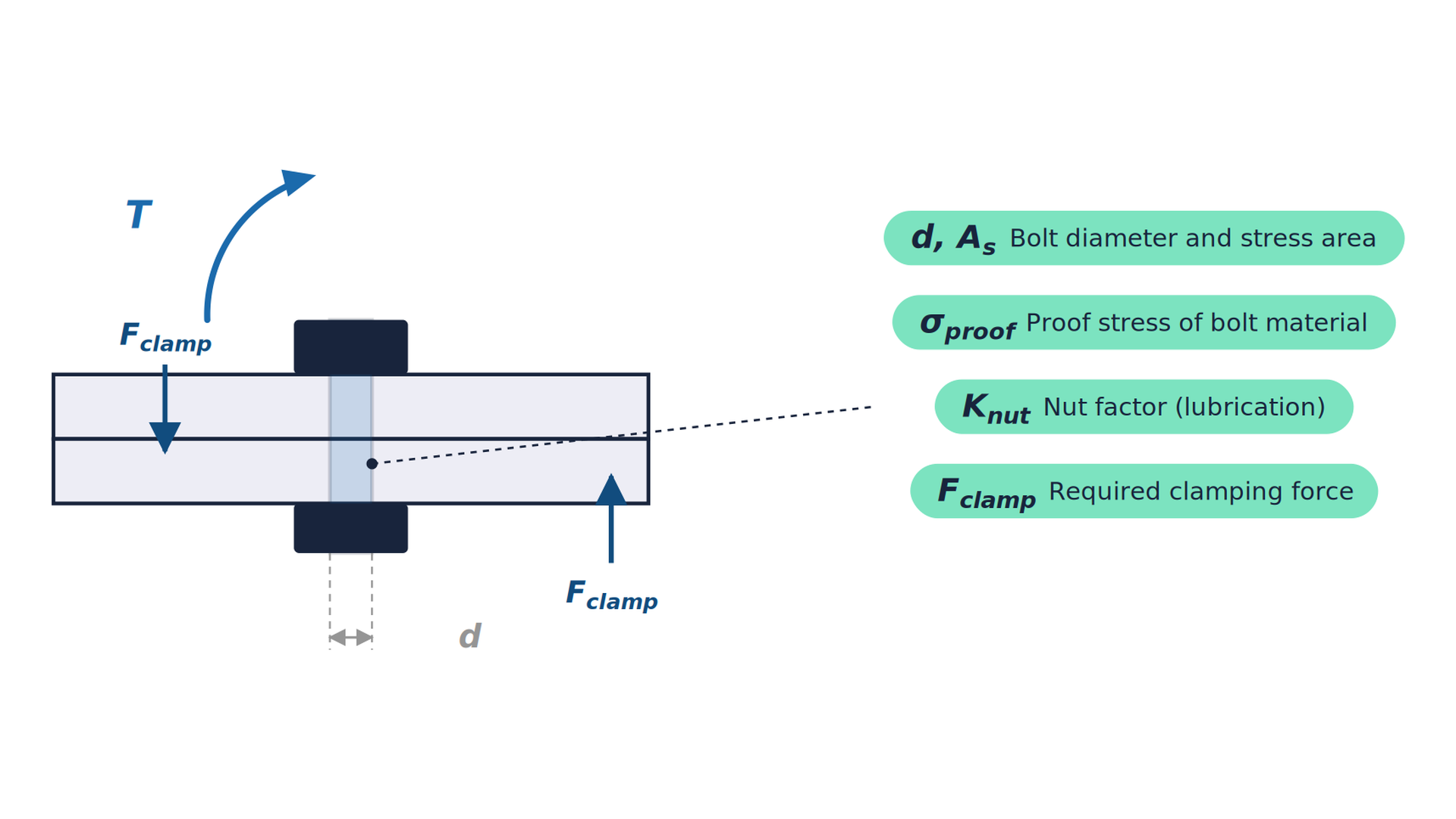
This calculator converts a required clamping force into a tightening torque and checks the bolt against its proof load. Method: the torque comes from the short-form torque-tension relationship T = K d F, where K is the nut factor, d the nominal diameter and F the target preload. The proof load is the proof stress multiplied by the tensile stress area, and the calculator reports the usual preload window of 75% to 90% of proof load. The tensile stress in the bolt and the ratio of clamping force to proof load show how hard the bolt is working; a ratio above 0.9 is flagged. Inputs are the nominal diameter, tensile stress area, proof stress (600 MPa for grade 8.8, 830 MPa for 10.9, 970 MPa for 12.9), nut factor and required clamping force. The nut factor carries most of the uncertainty. Around 0.2 suits dry, plain steel threads, while lubricated or anti-seize threads can be 0.1 to 0.15, so the same torque can give very different preloads. Where preload matters, such as fatigue-loaded or gasketed joints, consider controlling tension directly with hydraulic tensioning, direct tension indicators or ultrasonic measurement. Assumptions and limits: the short-form K relationship, a single bolt and room temperature. Embedding, relaxation, thermal effects, external working loads and joint stiffness are not included; VDI 2230 covers those for a full joint design. Typical uses: setting assembly torques for structural and machinery bolting, checking a specified torque against the bolt grade, and preparing torque tables for flanges, foundations and lifting equipment.
Referenced Standards
- VDI 2230 Part 1, Systematic calculation of highly stressed bolted joints
- Bickford, Introduction to the Design and Behavior of Bolted Joints