Fatigue Crack Growth Analysis
Estimate fatigue crack growth rate and remaining fatigue life using the Paris-Erdogan law for linear elastic fracture mechanics. Includes critical crack length and life assessment.
About This Calculator
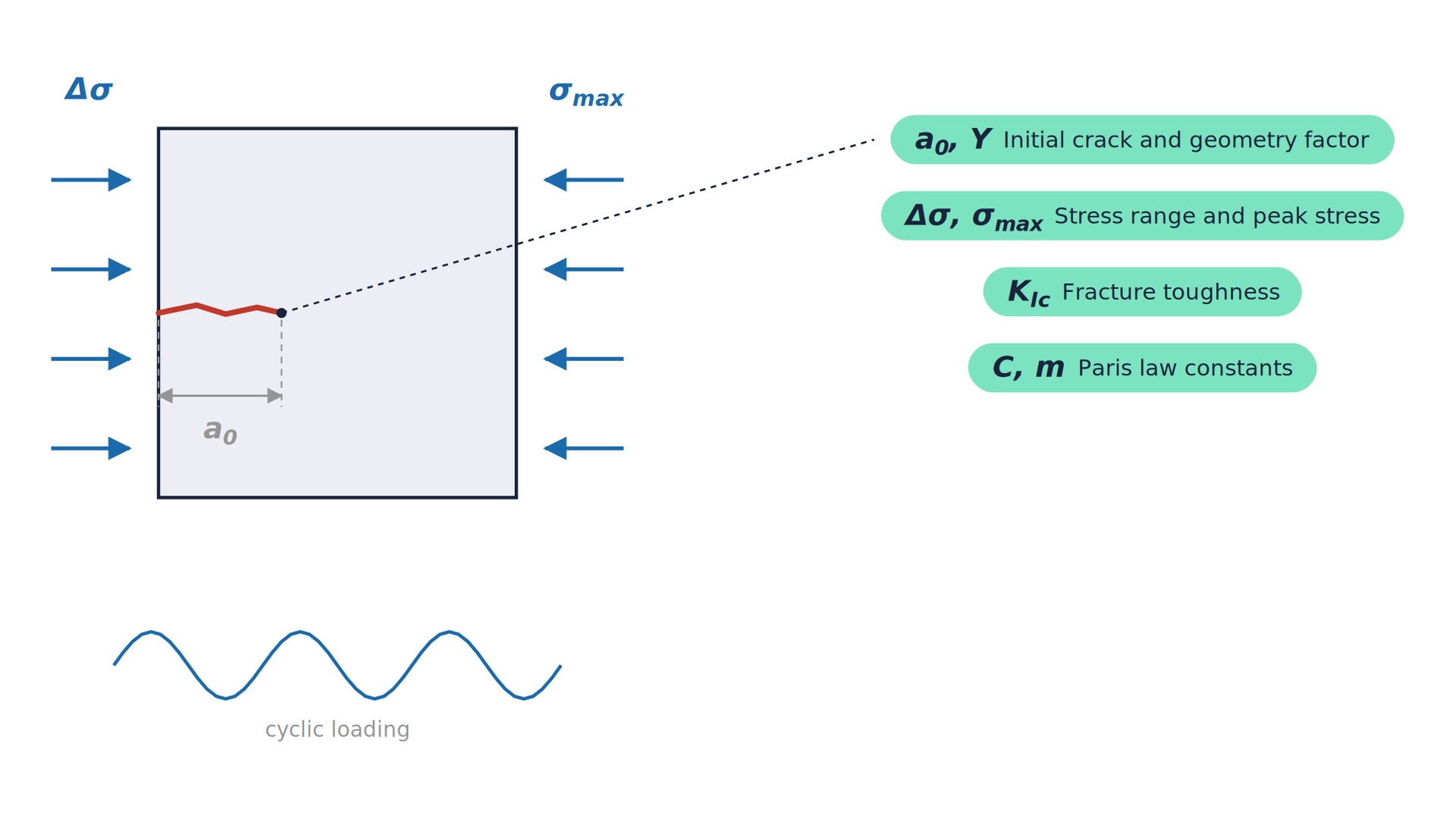
This calculator estimates how fast a fatigue crack grows and how many load cycles remain before it reaches the size that causes fast fracture, using linear elastic fracture mechanics. Method: the stress intensity factor range at the current crack length is ΔK = Y Δσ √(π a), where Y is a geometry factor (1.12 for an edge crack in a wide plate). The growth rate follows the Paris-Erdogan law, da/dN = C ΔK^m. The critical crack length is where the maximum stress intensity reaches the fracture toughness, a_cr = (K_Ic / (Y σ_max))² / π. Remaining life comes from integrating the Paris law in closed form from the initial crack size to the critical size, which is valid for m not equal to 2. Inputs are the stress range, maximum stress, initial crack length, geometry factor, fracture toughness and the Paris constants C and m, all in MPa and mm. Assumptions and limits: a constant geometry factor and constant-amplitude loading, with no threshold, crack closure or load sequence effects, and a crack that is small relative to the section. For welded or safety-critical components, use BS 7910 with suitable material data, and apply a margin when setting inspection intervals. Typical uses: setting inspection intervals for cracked or crack-prone components, judging whether a crack found in service can stay until the next shutdown, and seeing how sensitive the life is to stress range and starting defect size.
Referenced Standards
- Paris and Erdogan (1963), crack propagation law
- Anderson, Fracture Mechanics: Fundamentals and Applications
- BS 7910, Guide to methods for assessing the acceptability of flaws in metallic structures