Fillet Weld Sizing
Check fillet weld capacity using the simplified method from EN 1993-1-8. Determines design shear strength, applied and resisting forces per unit length, and utilization ratio.
About This Calculator
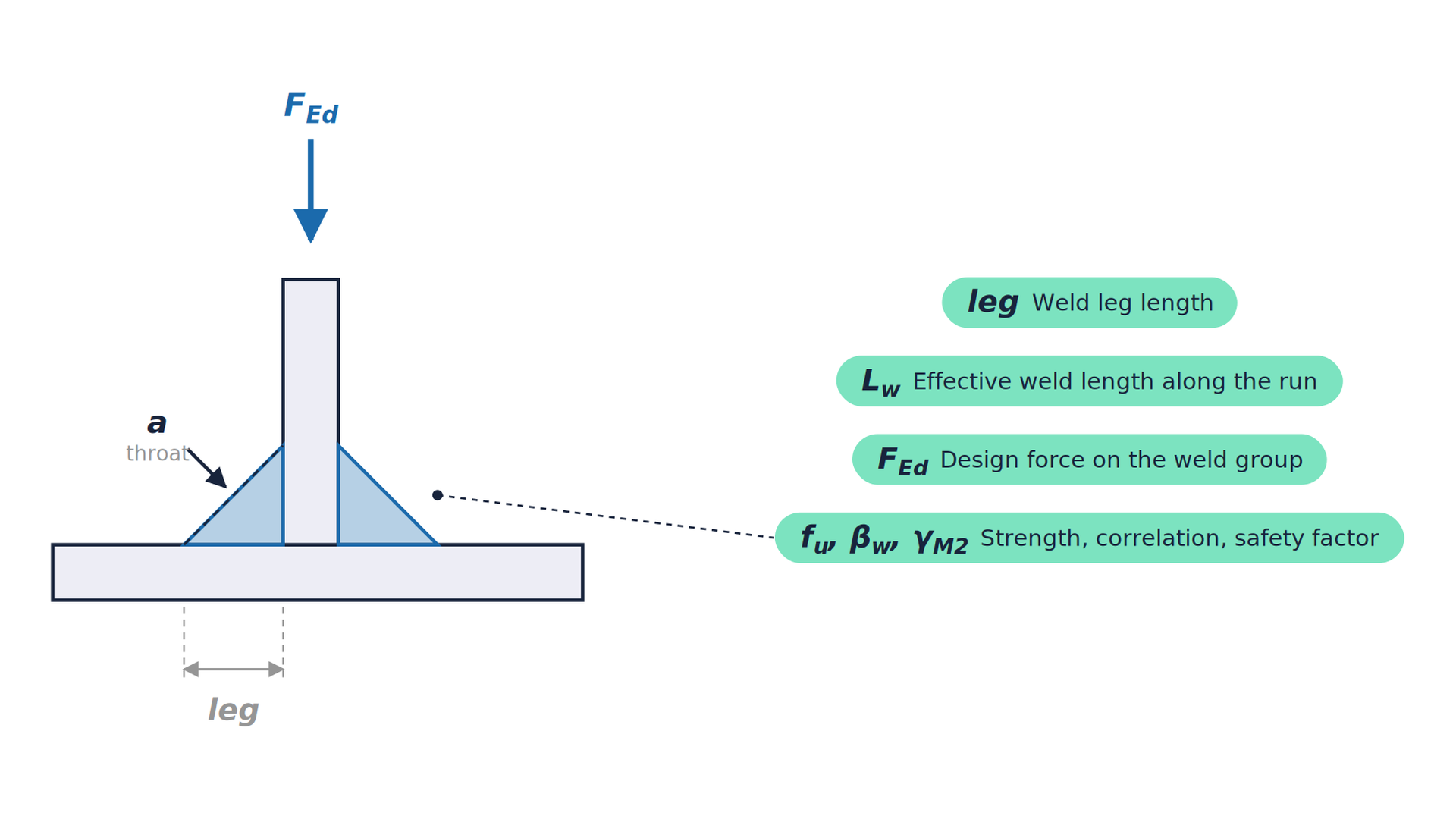
This calculator checks a fillet weld with the simplified method of EN 1993-1-8 clause 4.5.3.3, which treats the weld resistance as independent of the direction of the load. Method: the effective throat of an equal-leg fillet is a = leg / √2. The design shear strength of the weld is f_vw,d = f_u / (√3 β_w γ_M2), where f_u is the ultimate strength of the weaker part joined, β_w the correlation factor for the steel grade and γ_M2 the partial factor for joints. The resistance per unit length, f_vw,d × a, is compared with the applied force per unit length, F_Ed / L_w, and the total resistance of the weld is also reported. Inputs are the leg length, effective weld length, design force, the weaker part’s ultimate strength, β_w (0.8 for S235, 0.85 for S275, 0.9 for S355, 1.0 for S460) and γ_M2 (1.25 in the UK National Annex). Assumptions and limits: if the weld ends are not full size, the effective length should exclude them, normally by deducting twice the throat, and very long welds need the Eurocode reduction for long joints. The simplified method is conservative compared with the directional method of clause 4.5.3.2. Fatigue of welds, often the real limit on dynamically loaded equipment, needs a separate check, for example to BS 7608 or EN 1993-1-9. Typical uses: sizing fillet welds on brackets, stiffeners, padeyes and lifting lugs, cleats and structural frames.
Referenced Standards
- BS EN 1993-1-8, clause 4.5.3.3 (simplified method)
- SCI P363, Steel Building Design: Design Data
- BS 7608 or BS EN 1993-1-9 for weld fatigue