Thin Wall Pressure Vessel Analysis
Determine hoop and longitudinal stresses in a thin-walled cylindrical pressure vessel under internal pressure, with a von Mises equivalent stress check against an allowable stress.
About This Calculator
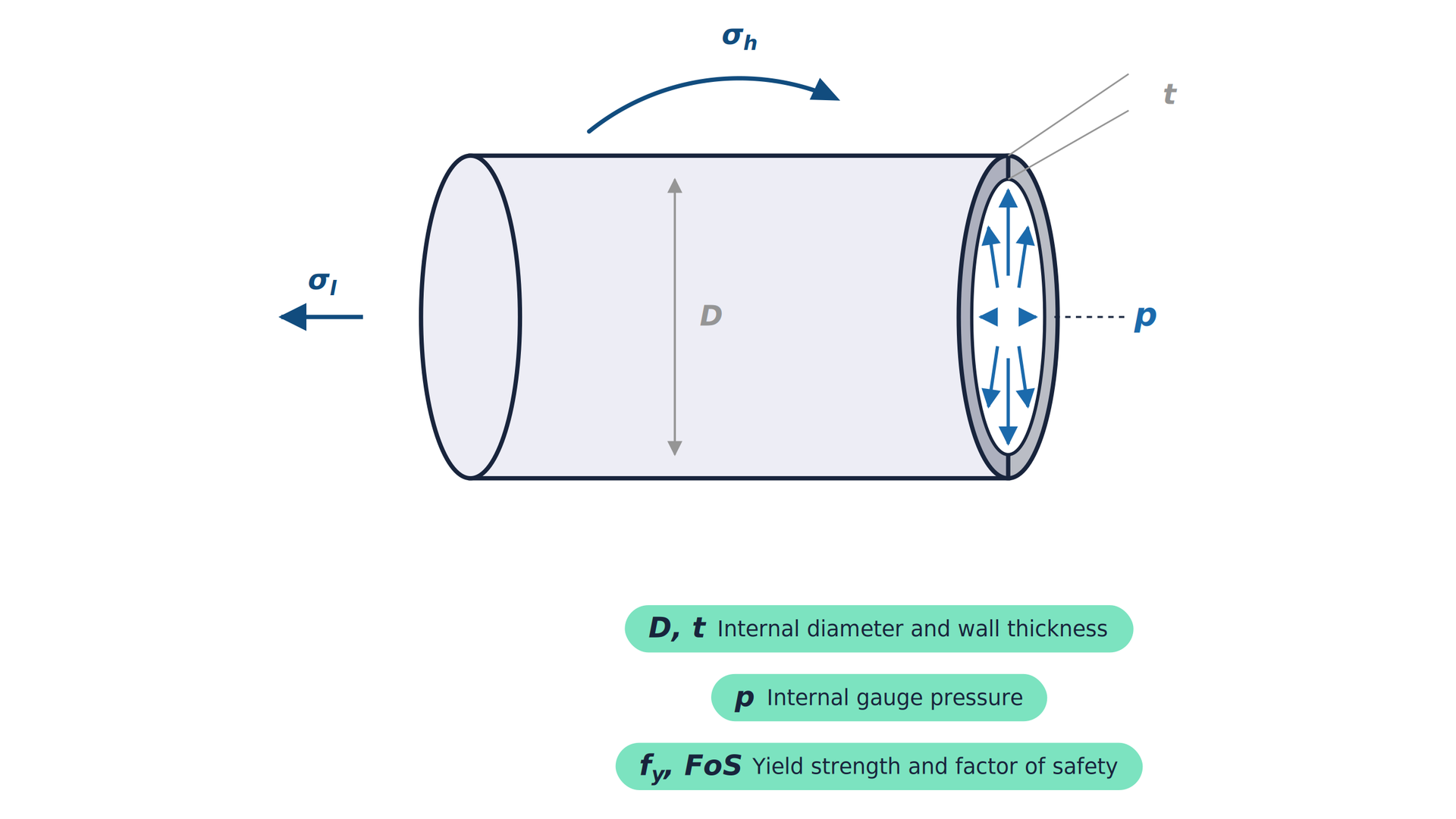
This calculator finds the membrane stresses in a thin-walled cylinder under internal pressure and checks the combined stress against an allowable value. Method: the hoop stress is σ_h = p D / (2 t) and the longitudinal stress is σ_l = p D / (4 t), where D is the internal diameter and t the wall thickness. They are combined into a von Mises equivalent stress, √(σ_h² + σ_l² − σ_h σ_l), which is compared with an allowable stress of yield divided by the chosen factor of safety. The ratio D / t is checked against 20, the usual limit for thin-wall theory; below it, use the thick-wall (Lamé) equations. Inputs are the internal diameter, wall thickness, internal gauge pressure, yield strength and factor of safety. Assumptions and limits: a long cylinder away from heads, nozzles and supports, a uniform wall, internal pressure only, and radial stress ignored. It does not cover corrosion allowance, weld joint efficiency, external pressure or buckling, local stresses at openings and attachments, or fatigue. Pressure equipment is designed and certified to codes such as BS EN 13445 or PD 5500, which set their own allowable stresses and rules, so use this as a first sizing check. Typical uses: first sizing of shells for pressure vessels, receivers, accumulators and pipe sections, checking an existing wall thickness against a new working pressure, and hydraulic and pneumatic enclosures.
Referenced Standards
- Young and Budynas, Roark’s Formulas for Stress and Strain
- BS EN 13445-3 or PD 5500 for pressure vessel design