Boat Unloader
Subco Engineering delivered a fully engineered, rail‑mounted boat unloader system for PD Ports, designed to safely transfer a wide range of vessels from quayside to workshop. Through phased development, detailed load‑case modelling, adjustable trolley and cradle design, and a robust winch‑and‑sheave system, Subco created a flexible, future‑proof solution that enhances operational safety, efficiency, and reliability. The final system provides PD Ports with precise vessel handling, improved repeatability, and long‑term adaptability.
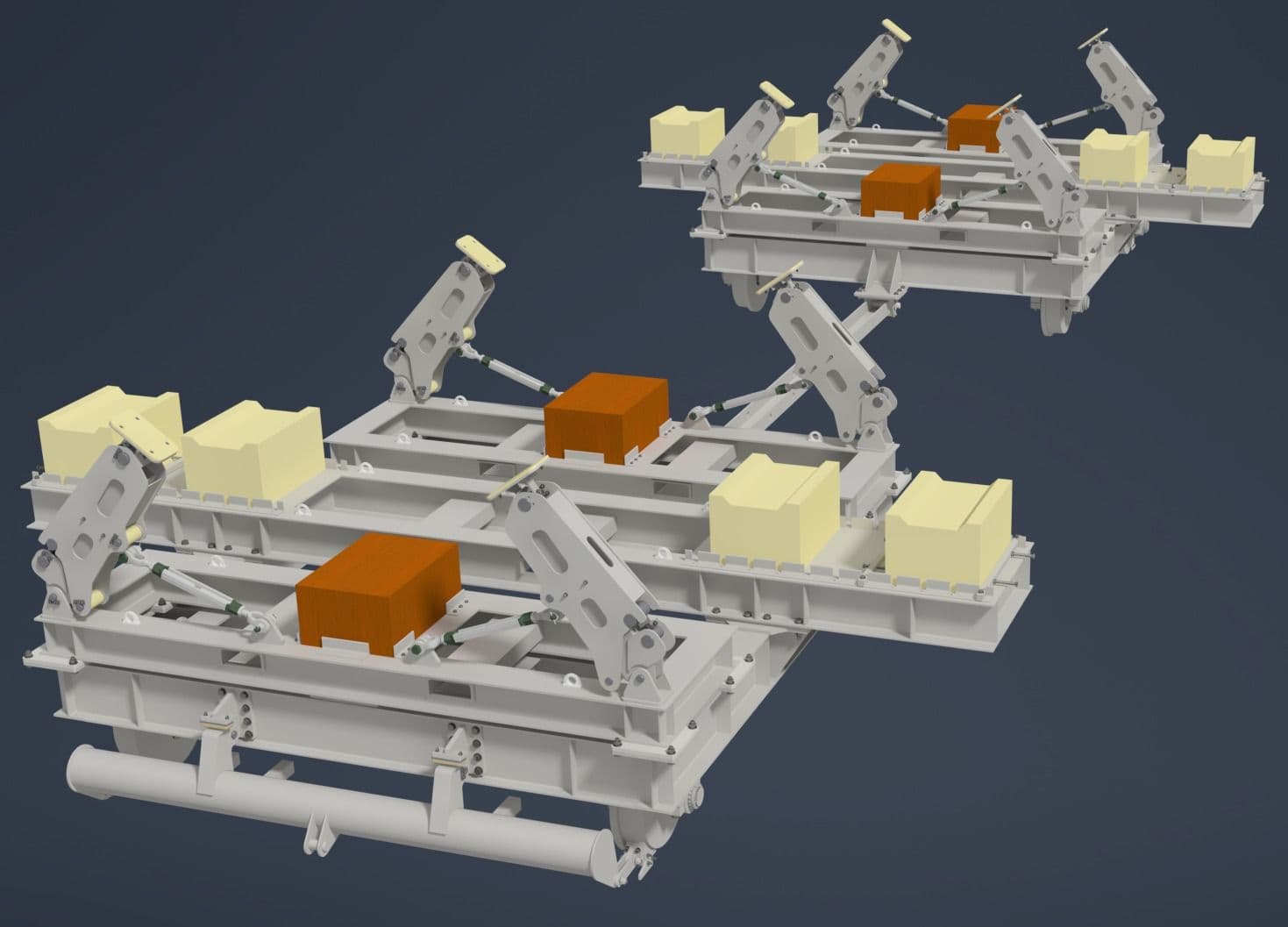
Case Study: Engineering a Bespoke Boat Unloader System for PD Ports
Overview
Subco Engineering partnered with PD Ports to design and deliver a robust, rail‑mounted boat unloader system capable of transporting vessels safely and efficiently from quayside to workshop. The project demanded deep technical insight, adaptable engineering, and close collaboration across multiple disciplines. The resulting system provides PD Ports with a highly configurable, future‑ready solution engineered for reliability and operational safety.
The Client Challenge
PD Ports required a system to move a range of vessels — from smaller boats to those up to 35–40 tonnes — from the water into a maintenance shed. The solution needed to:
- Accommodate multiple vessel types, each with different hull geometries and masses
- Operate safely in challenging maritime environments with strict wind‑speed, load, and operational limits
- Interface with existing quay and rail infrastructure
- Provide a repeatable, dependable workflow for crews performing vessel transfers
Early assessments showed that critical loading assumptions (e.g., vessel weight readings) were sometimes inaccurate, meaning the engineering solution had to be robust enough to tolerate real‑world variability.
Our Approach
Subco Engineering delivered a phased design programme covering concept development, detailed engineering, and project close‑out. This structured approach ensured clarity, control, and adaptability throughout.
1. Front‑End Concept Development
The first phase included:
- Full load‑case modelling
- Basic trolley concepts and weight estimation
- Preliminary winch specification and ground loading assessments
- AutoCAD layouts showing rail locations, winch positioning, and diverter sheave arrangements
This established a strong design foundation and enabled PD Ports’ civils teams to begin early planning with accurate data.
2. Detailed Mechanical Design
The next stage translated concepts into engineered systems with defined geometry, components, and interfaces. Key elements included:
Dual‑Trolley System
- Two trolleys, adjustable from 5–8m centres, enabling flexible vessel support positioning
- Each trolley equipped with four wheels operating on A65 crane rail or BS113A flat‑bottom rail for maximum stability
Adjustable Support Cradles
- Multiple vertical and lateral supports to suit a wide variety of hull forms
- Lateral support angular adjustment between 95°–125° and height adjustment of approx. 500mm, ensuring a secure, tailored fit for each vessel type
Winch & Sheave System
- Dual winches providing controlled pull with defined operational and static load ratings
- Ground anchors, diverter sheaves, and tow points engineered for predictable and safe vessel movement under load
3. Safety & Operational Engineering
Operational limits were clearly defined, including:
- Maximum operational wind speed of 15 m/s and survival wind speeds up to 23.7 m/s
- Transverse and longitudinal load design criteria
- Clearly documented PPE and operational procedures within the O&M manual
Delivering the Final System
At project conclusion, Subco Engineering delivered a comprehensive package including:
- Full drawing set (PDF & DXF for fabrication)
- O&M manual for safe operation and maintenance
- Technical specifications and loading documentation
- Final engineering close‑out report summarising performance, lessons learned, and contractor feedback
The final close‑out documentation confirms the system comprises a rail‑mounted, dual‑trolley configuration with adjustable supports, moved by a paired winch system — purpose‑designed to reliably handle two main vessel classes with precision and safety.
Project Impact
The new boat unloader system provides PD Ports with:
✔ Greater Operational Control
Precise load distribution, modular cradle components, and controlled winch movement allow reliable vessel transfers independent of vessel type or hull shape.
✔ Improved Safety and Repeatability
Engineering controls and detailed O&M processes ensure teams can move vessels safely with consistent methodology.
✔ Future‑Ready Flexibility
The system’s wide range of adjustments enables PD Ports to support future vessels without major redesigns, protecting long‑term investment.
✔ Engineering Assurance
Subco Engineering’s detailed load cases, rigorous design checks, and structured project delivery provide clear traceability and confidence in system performance.
Sector:
FAQ's
Can you design a handling system for a mixed fleet of different vessels?
Yes, and that's usually the whole point. Most operators don't have one boat, they have a range of hull shapes and weights that all need to use the same infrastructure. For PD Ports we built a dual-trolley system with cradles that adjust both in height, by around 500mm, and in lateral angle between 95 and 125 degrees, with the trolley centres sliding anywhere from 5 to 8 metres. One system, tailored on the day to whatever vessel is coming out of the water. That flexibility is designed in from the start rather than bolted on later.
What if we don't have accurate weights or data for our vessels?
That's a common situation and we design around it. On this project the early vessel weight readings weren't always reliable, so we didn't treat them as gospel. We built the load cases with enough margin to tolerate real-world variability, which means the system stays safe even when the numbers you start with turn out to be off. If your data is patchy, tell us. We'd rather engineer for the uncertainty than pretend it isn't there.
How do you handle safety in a working maritime environment?
We set clear, calculated operating limits and put them in writing. For the boat unloader that meant a maximum operational wind speed of 15 m/s, a survival case up to 23.7 m/s, and defined transverse and longitudinal load criteria the whole system was checked against. Those aren't cautious guesses. They come out of the engineering, and they end up in the O&M manual alongside the PPE and operating procedures so the crew knows exactly where the boundaries are.
What do we actually receive at the end of the project?
A complete package you can build, operate and maintain from. On this job that was the full drawing set as PDF and DXF ready for fabrication, an O&M manual, the technical specifications and loading documentation, and a close-out report covering performance and lessons learned. The idea is that you're not left dependent on us to understand your own asset. Everything needed to run it, service it, and hand it to a contractor is in your hands.
Will the system still work if we bring in different vessels later?
It should, because we design for the fleet you'll have, not just the one you have now. The adjustable cradles, the sliding trolley centres and the range of support positions were all specified so PD Ports could take on vessels they hadn't bought yet without commissioning a redesign. That protects the money you spend today. A bespoke system doesn't have to mean a narrow one, and getting that balance right is part of the job.