Subsea Riser Clamps
Subco turned around a subsea riser clamp concept design and costing basis in just two days, working over the weekend, so our customer could obtain manufacturing quotations and price the work to their end client. We then finalised the design with a full suite of calculations, detailed FEA, manufacturing drawings and FAT load‑testing documentation across two riser diameters and their associated tensile capacities, all produced in the client's own templates. The client won the work, and we supported through the pull‑test FAT.
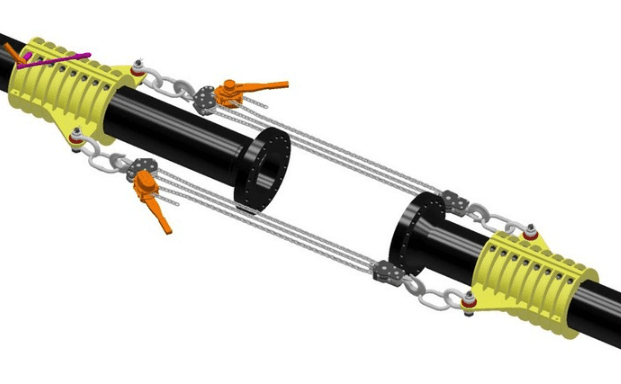
Subsea Riser Clamps
Subco Engineering were engaged by a client to turn around a subsea riser clamp concept design, and the supporting costing information, within an extremely tight two‑day window, working through the weekend to meet the deadline. This early definition allowed our customer to go out to the market for manufacturing quotations and provide their final price to the end client.
Overview
Subco developed the concept design and costing basis for a set of subsea riser clamps, then carried the work through to a fully engineered solution — a complete suite of calculations, manufacturing drawings, and the load‑testing documentation required for factory acceptance testing (FAT). All documentation was produced within the client's own borders, using their templates and house style.
How the Clamps Work
The clamps secure a flexible riser using two clamp halves that compress a thin polyethylene sheet against the pipe, which is itself coated in a tri‑layer polypropylene system. Grip is generated purely through bolting loads, so the behaviour of the bolted connection is central to how the clamp performs. Getting the preload right is what allows the clamp to hold the riser securely without over‑compressing or damaging its coating.
The Challenge
The customer needed a credible concept design and a costing basis fast, within a matter of days, so they could obtain manufacturing quotations and return a firm price to their end client. On top of the compressed programme, the design had to:
- Cover two different flexible riser diameters, each with its own associated tensile capacity load
- Generate grip through bolting alone, without over‑compressing or damaging the riser's polypropylene coating
- Be demonstrably compliant with recognised standards and provable by physical test
Our Approach
Working over the weekend, Subco produced the concept designs and costing information covering the two riser diameters and their two tensile capacities. We then finalised the design with detailed finite element analysis (FEA) to determine the structural stiffness of the clamp and its effect on the bolting preloads; the key driver of clamp performance. The two riser sizes and load cases were carried through into two distinct sets of documentation.
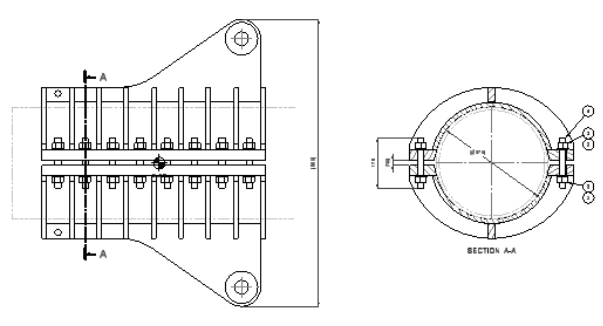
We also specified the bolting sequences as part of the installation and testing documentation, so the clamps could be assembled and preloaded correctly and repeatably, both in service and during test.
The design and load testing were developed in line with Lloyd's Register Rules for Lifting Appliances in a Marine Environment (2024) and DNV‑OS‑H205.
Deliverables
Across the two riser diameters, Subco delivered:
- Concept design and supporting costing information, turned around within two days
- A full suite of structural calculations, including detailed FEA of clamp stiffness and bolt preloads
- Manufacturing drawings produced in the client's own templates and house style
- Load‑testing documentation — test methods and risk assessments — for a FAT in which the clamps were pull‑tested on a dummy pipe spool piece
- Specified bolting sequences for installation and testing
- Two complete documentation sets, one for each riser diameter and its associated tensile capacity
Outcome
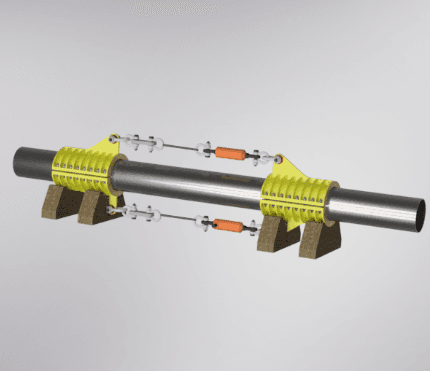
The rapid turnaround gave the customer exactly what they needed: a costed, credible design they could take to market for manufacturing quotations and use to price the work to their end client, which they won. We continued to support through delivery, including assisting on calls during the factory acceptance testing as the clamps were pull‑tested on the dummy spool piece.
It isn't our usual way of working, but when a customer is up against an immovable deadline, sometimes the right answer is to roll up our sleeves and get the job done so they can benefit.
Sector:
FAQ's
How quickly can Subco turn around a concept design and costing?
For this project, two days, working over the weekend to hit the client's deadline. Not our standard way of working, but we can mobilise fast when a deadline is immovable
How do the riser clamps hold the pipe in place?
Two clamp halves compress a thin polyethylene sheet against the coated riser. Grip comes entirely from bolting loads, so the bolt preload holds the riser securely without damaging its coating.
What standards was the design carried out to?
Lloyd's Register Rules for Lifting Appliances in a Marine Environment (2024) and DNV-OS-H205.
How were the clamps proven?
By a factory acceptance test (FAT), pull-testing the clamps on a dummy pipe spool. Subco produced the test methods and risk assessments and supported the client through testing.