The Plain-English Guide to Hydraulics
How hydraulics actually works, where it shows up across industrial, offshore, and renewable equipment, and the handful of principles worth remembering before the detail starts to matter.

Matthew Majtyka
Lead Engineer
What you will learn
- Where hydraulic power turns up in real equipment, from industrial presses to subsea ROVs and wind turbine pitch control
- Why hydraulic power is often the go-to choice when space and weight are constrained
- The difference between fixed and variable displacement pumps, and why it matters
- How pressure and flow actually relate to each other, and why that's the one point most people get backwards
- How a basic open-loop hydraulic circuit works, using a pump, valves, and a cylinder
What is hydraulics?
Hydraulics is simply the engineering sub genre for anything fluid related. In simple terms, it tackles the "how do we make things move or rotate by using fluid" (quite often some type of oil) and it’s used all around us.
Then the slightly more engineering focused definition would be, hydraulics is the mechanical means of transmitting power from a source to one or many points at which force or movement is required.
So why hydraulics?
Before joining Subco, I actually worked for a hydraulics company designing hydraulic systems, mainly for the offshore industry. And hydraulics is really an interesting area that’s often overlooked, so I wanted to share some of my experience with the team.
Where is hydraulic power used?
Hydraulics is commonly seen in industrial machines, offshore and subsea equipment as well as in renewable energies sector. Some examples of hydraulic-powered equipment:



The advantages of hydraulic power
- High power density, which can reach up to 5kW/kg
- Good control capabilities and fast response times with modern valves
- High positioning precision with servo controlled closed-loop valves
- Self-braking and load holding capability due to incompressibility of the oil
- Ability to operate in adverse conditions when systems are designed correctly
Most notably, hydraulic motors can deliver up to 10x more power per kilogram than electric motors. This makes hydraulic power a go-to choice, especially when space is constrained.
Fluid Power Principles
The Prime Movers
Pumps are driven by AC & DC electric motors, diesel engines, or even hydraulic motors. Whilst 3-phase AC electric motors are the traditional choice, there is a constant drive for higher efficiency systems as energy costs keep rising. A relatively small 15kW hydraulic power unit, running for 12hrs a day in a factory, costs the operator over £16k a year in energy costs. Operators trying to reduce this overhead are investing more initially on Variable Frequency Drives (VFDs), variable displacement pumps and higher efficiency motors.
Pumps
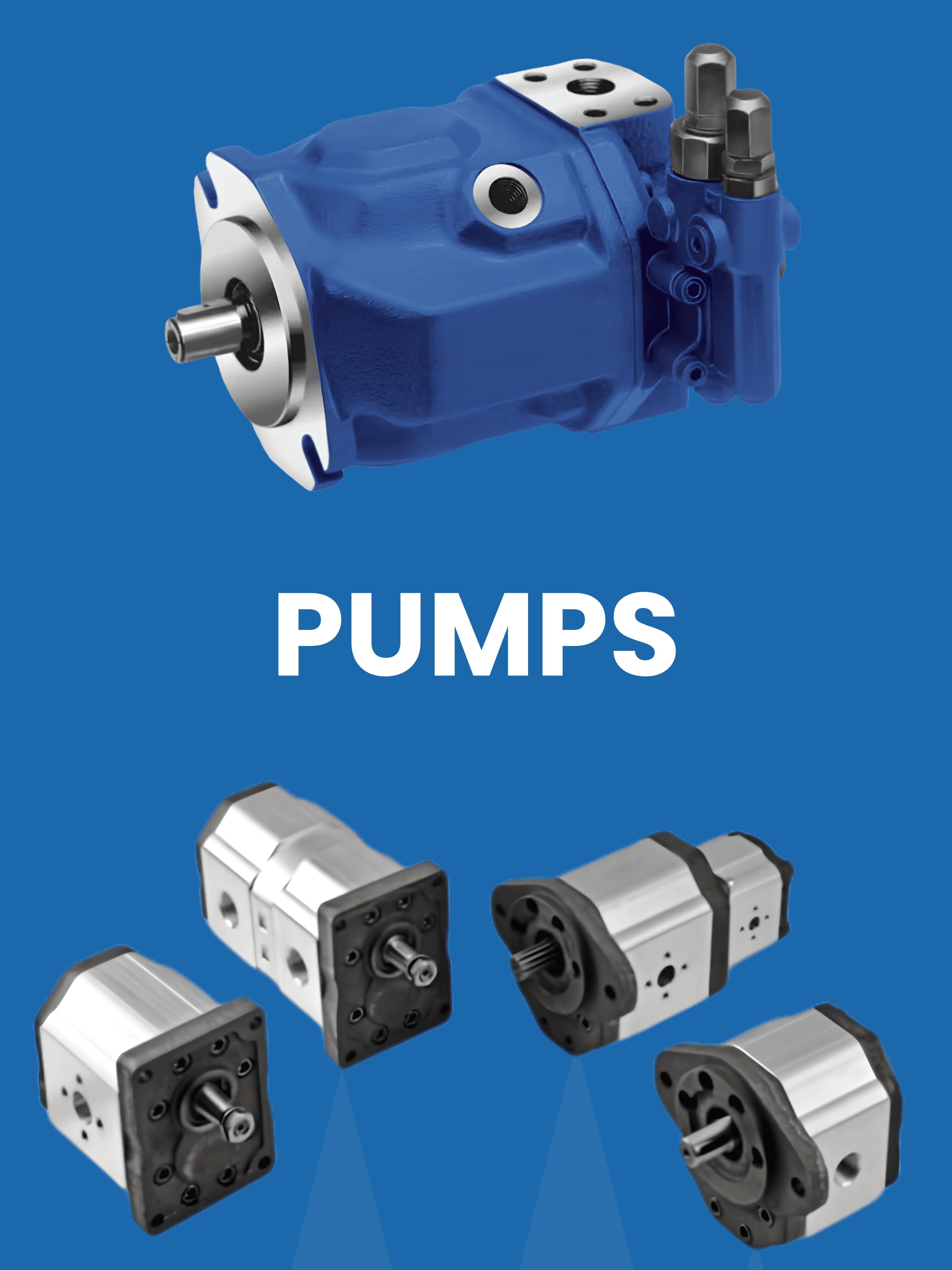
Pumps transfer fluid to actuators to perform mechanical work. Pumps are often categorised by their flow delivery characteristic: fixed or variable displacement. Fixed displacement pumps deliver a "fixed" amount of oil per revolution, dictated by the displacement of the pump, often measured in cc/rev. These are the simplest and cheapest types of pumps available on the market and serve quite a large proportion of systems. Variable displacement pumps can vary the amount of flow supplied per revolution by adjusting the angle of the swash plate. This is very useful for equipment which can have long stand-by periods as the flow can be reduced to minimum, in turns saving energy. Another advantage is the many control possibilities available from various manufacturers; load sensing, remote control, pressure and flow control to name a few.
Valves
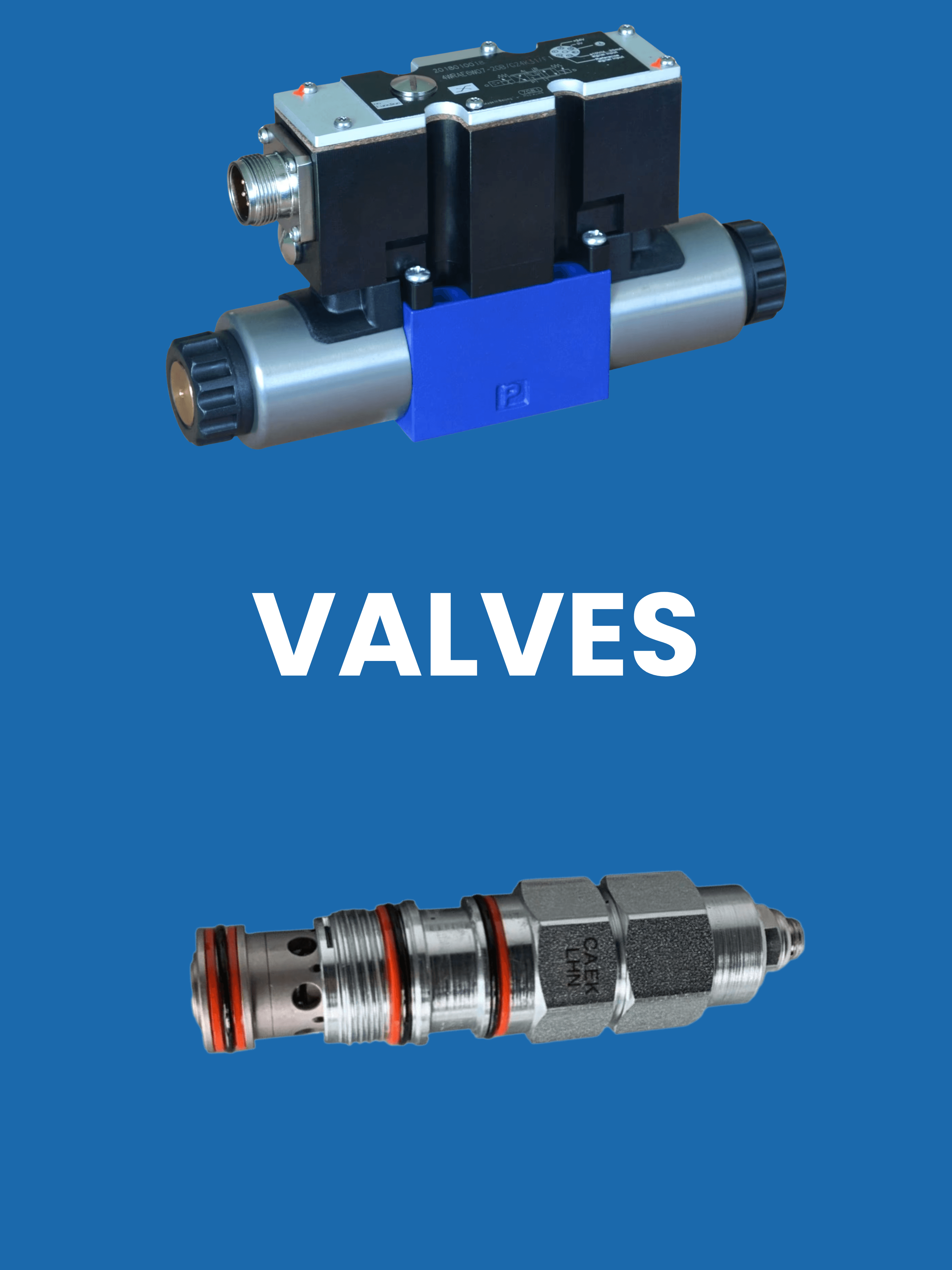
Valves control flow and pressure of fluid to achieve the desired function. Depending on size of the valve, they can be standalone components, mounted directly to pipework or cartridge style screwed into a manifold block. There are also some standard valves, often called ISO or NG, which can be stacked together, to build the required functionality.
Actuators
Actuators perform the mechanical work with fluid supplied by the pumps. These are either linear or rotary, for example, cylinders and motors. A series of linear and rotary actuators are often used to carry out complex movements. Think of a digger, with its rotating cab and articulating arm.
System Types
Two types of hydraulic system: open-loop and closed-loop. In an open-loop system, the pump draws oil from a reservoir and after circulating through the system comes back there. This allows the oil to deaerate, cool passively and also allows contamination to drop to the bottom of the tank before the oil is drawn back by the pump. In a closed-loop system, the returning oil comes back straight to the lower pressure side of the pump. This approach requires careful heat and contamination management but is often used in situations where an oil tank is impractical, for example, in subsea applications or plant machinery where a compact bi-directional system is required.
Pressure vs Flow
Pumps produce flow — not pressure. Pressure is the result of resistance to motion. Fluids always take the path of least resistance. This is the most important point which is quite often misunderstood.
Basic Hydraulic Circuit Example — Open Loop System
Circuit
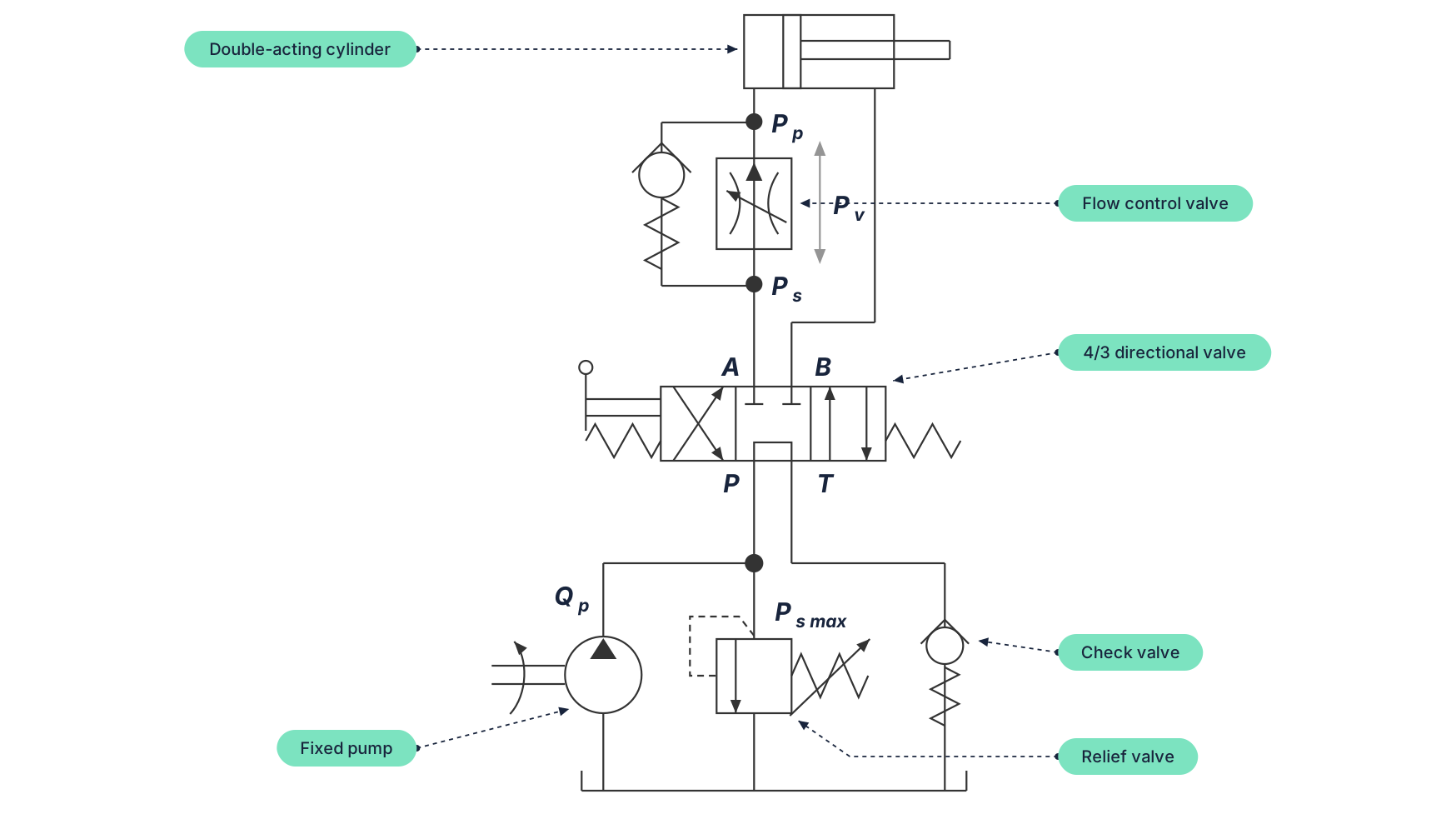
Shown above is an example of a simple hydraulic system. The actuator here could be used to move and hold a part into position.
Working Principle
Pump provides oil flow to the system. With the directional valve in its neutral position, P (pressure) line is linked to the T (tank) line, so oil will be circulating with minimal pressure. As soon as the lever on the valve is pushed to the left, P will be connected to the A service line, sending oil to the full-bore side of the cylinder, making it extend. The relief valve is there to protect the system from over-pressure, for example, if the cylinder hits a dead end the pump will continue to send oil which will have nowhere to go, hence a relief valve is required to allow this oil back to the tank. Check valves only allow flow in one direction and the flow control valve is used here to regulate the extending speed of the cylinder.
The thing I’d want a client to actually remember
The most important principle to remember in hydraulics is one that is often confused. Pumps provide flow, NOT pressure. Pressure is the by-product of resistance to motion. Think of a syringe, it is quite easy to move the plunger when the tip is free and open, once your thumb covers the open end, it becomes really difficult to push; the pressure required to move increases, as the blocked tip is resisting the air escaping.
Frequently Asked Questions
Why is hydraulic power so commonly used?
It's not a matter of simplicity. In fact hydraulics systems are a lot more complicated than electric ones. But engineers still go hydraulic because of the power - weight ratio. It useful in cases where you're looking to generate huge force/torque from a compact unit
Do pumps produce pressure or flow?
Pumps produce flow and then pressure is just the result of the resistance to motion.
What's the difference between a fixed and a variable displacement pump?
A fixed displacement pump delivers a set amount of oil per revolution every time. A variable displacement pump can deliver a varying amount of oil per revolution every time.
In a basic circuit example, what stops the pump from over-pressurising a system at dead end?
It's not like a pump knows that a cylinder has stopped. So flow continues and as mentioned earlier pressure builds as the by- product, but there's no where for that pressure to be released. That's why there's a relief valve. It's tuned to crack at specific pressure and dumps excess flow back into the tank.