Weld Decay in Stainless Steels
How weld decay attacks stainless steels at the heat affected zone during welding, and the material selection and fabrication practices that prevent it.

Martin Reynolds
Strategy Director | Engineer
What you will learn
- Understand the mechanism of chromium carbide precipitation during welding
- Know when to specify low carbon (L) grades versus stabilised grades
- Identify service environments where weld decay risk is highest
- Apply prevention strategies at the specification stage
Prerequisites
- Basic understanding of stainless steel grades
- Familiarity with welding processes
What is Weld Decay?
Weld decay is exactly what it sounds like. A weld, or moreover the areas surrounding the weld (in the HAZ), slowly decaying.
It happens because of chemical changes taking place right at the welded joint during the welding process.
So why insist on lower carbon grades, like 316L, for certain welds? Simple. Weld decay.
Heat from the welding lets chromium carbides form along the grain boundaries near the weld. That depleted area eventually loses the corrosion resistance the parent metal was supposed to have. What you end up with is a material sold as stainless that actually corrodes right where you weld it.
It shows up mostly in pipework, vessels, and structural welds in chloride rich or acidic environments, because that weakened zone is the first place that gives out.
Why Does Welding Cause This in the First Place?
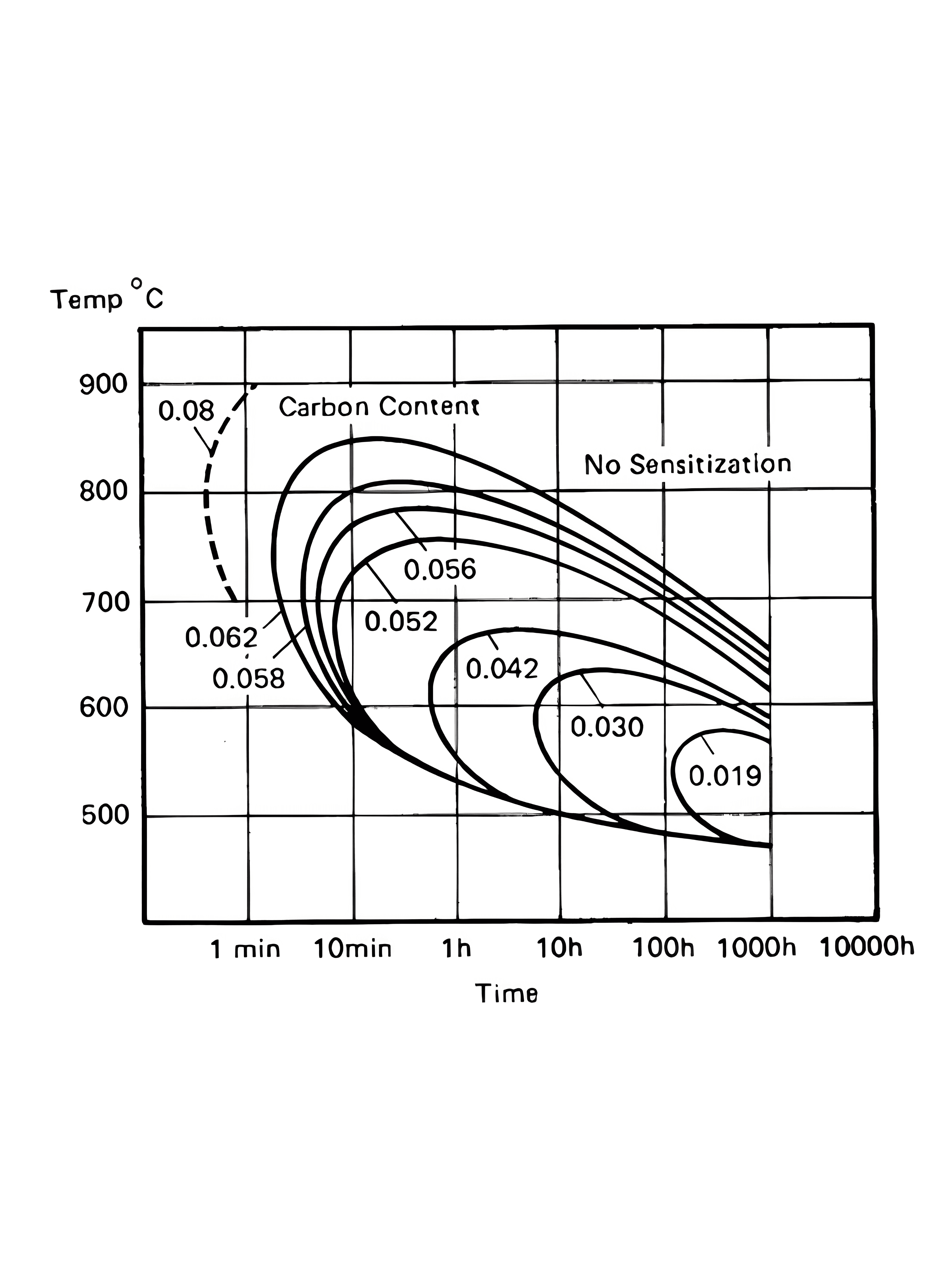
Weld decay isn't damage from the weld itself. The fusion zone, where the metal actually melted and re solidified, usually comes through fine. The real problem sits a short distance away, in a band of parent metal that never melted but got carried through the sensitisation temperature range, roughly 500 to 800°C, as heat spread out from the weld pool and then faded away, this is known as the Heat Affected Zone (HAZ).
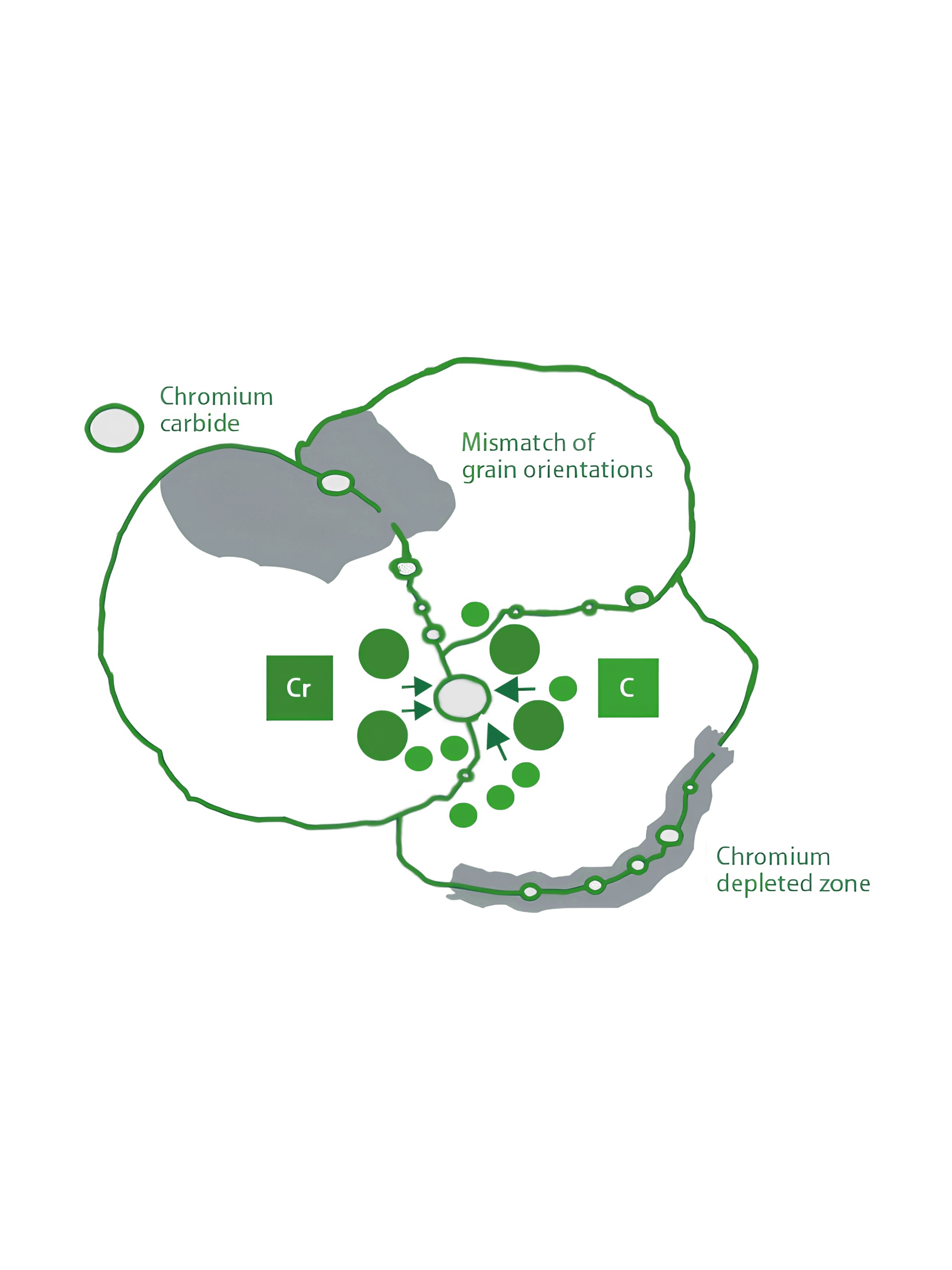
Inside that temperature window, chromium and carbon in the steel have enough mobility to combine and form chromium carbide along the grain boundaries. Those carbides pull chromium out of the narrow zone right around them. Chromium is what gives stainless steel its passive, corrosion resistant film in the first place, so that narrow zone can drop below the roughly 10.5 to 12% chromium it needs to stay passive, even though the material on either side of it is still fully alloyed.
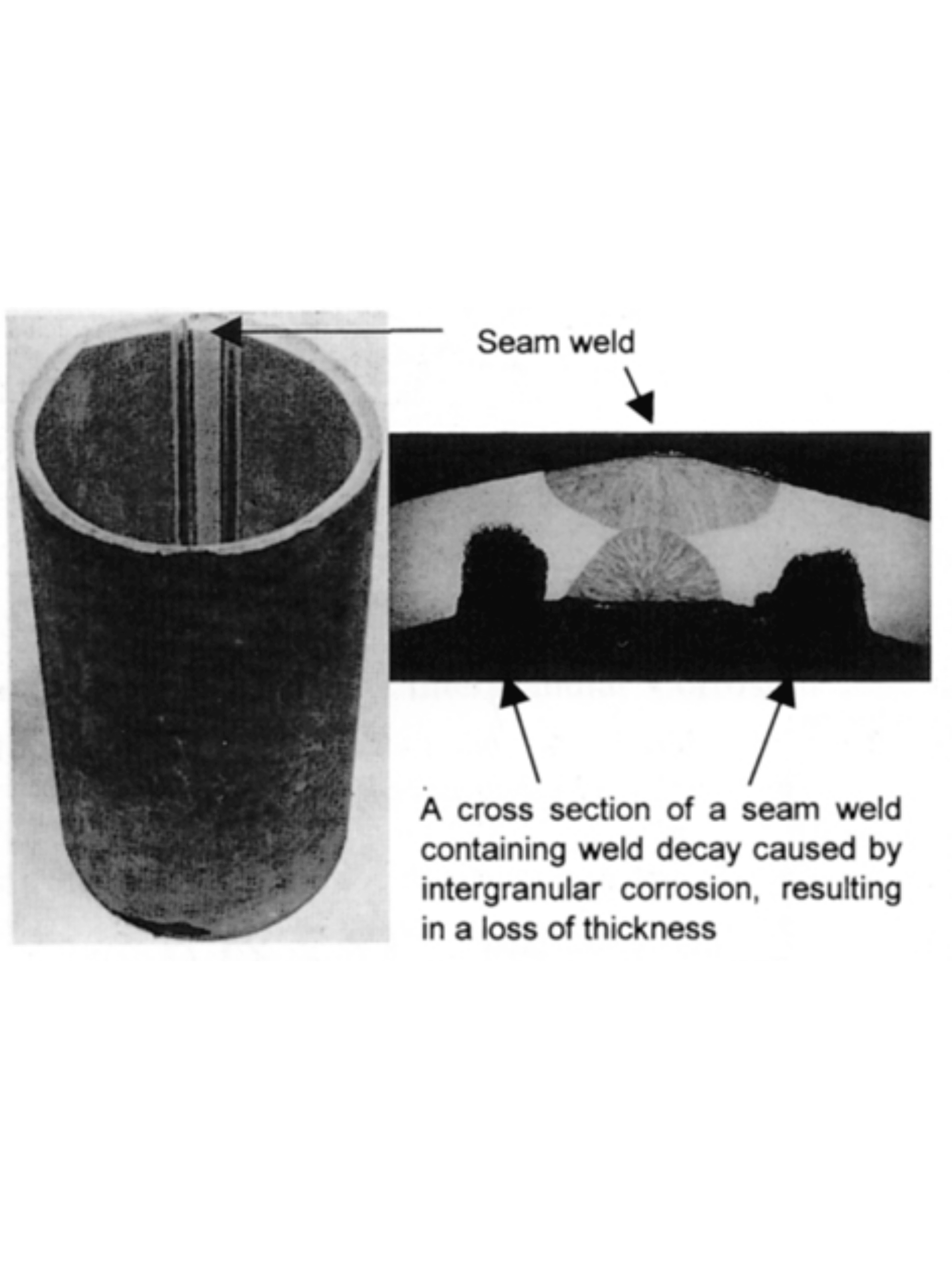
The result is a continuous, corrosion vulnerable path running in a band on either side of the weld, not through it, following the grain boundaries like a pre drawn line. In a corrosive environment, that band corrodes while the fusion zone and the unaffected parent metal either side of it stay intact. It's why weld decay has such a distinctive look. Two parallel grooves of attack running alongside a weld that itself looks completely fine.
This is also exactly why low carbon and stabilised grades work, for two different reasons.
- Low carbon (L) grades cap carbon content at around 0.03%, against roughly 0.08% for the standard grade. Less carbon available means less chromium carbide can form in the first place, so the depleted zone never drops far enough to lose passivity.
- Stabilised grades (321, 347) add titanium or niobium, which bond to carbon before chromium does. The carbon gets tied up as titanium or niobium carbides instead, leaving the chromium in solid solution where it's actually needed.
Stabilised grades carry their own related risk worth knowing about: knife-line attack. If a stabilised weld is later reheated into the carbide-dissolving range (above roughly 1150°C) and then cooled back through the sensitising range without a proper anneal, the titanium or niobium carbides can redissolve and chromium carbide can reprecipitate — producing a very narrow band of attack immediately adjacent to the fusion line, rather than the wider band typical of ordinary weld decay. It's the same underlying mechanism, just triggered by a second thermal cycle the original stabilisation was supposed to prevent.
Known Failures: What Weld Decay Has Taught Structural Engineering
| Case | What happened & What it taught us |
|---|---|
| Dresden Unit 1 nuclear plant, 1965 | Back in December 1965, a pressure test at the Dresden Unit 1 boiling water reactor turned up a leak in a 6 inch bypass line. It turned out to be the first documented case of intergranular stress corrosion cracking ever found in a commercial nuclear plant. Investigators traced it back to weld sensitised 304 stainless piping, being attacked by the reactor's own high purity, oxygenated water at operating temperature. What started as a single leaking pipe turned into a fleet wide problem over the next two decades, eventually showing up in large diameter recirculation piping, safe end welds, and reactor internals too. The industry's response changed nuclear piping standards worldwide. Low carbon and stabilised stainless grades became the norm for BWR piping, hydrogen water chemistry got introduced to cut the dissolved oxygen driving the cracking, and controlling weld heat input became a formal, regulated part of fabrication. Sixty years later, Dresden is still the reference point for why sensitisation isn't just a theoretical risk, even in a tightly controlled water chemistry environment. It's the failure that shaped an entire generation of nuclear piping standards. |
| Petrochemical CO2 pipeline, failed within months | A welded 304 stainless pipeline carrying CO2 at a petrochemical plant started cracking next to its weld joints after only a few months in service, nowhere near the years or decades a healthy stainless system should last. Investigators found the failure began through pitting and stress corrosion cracking, concentrated right in the weld heat affected zones, driven by a mix of residual welding stress and chloride from the surrounding soil. What really stands out here is how fast it happened. This wasn't some slow problem that inspectors missed over years. Once the sensitised band, the leftover stress, and a chloride source all lined up together, the pipeline burned through most of its service life in a matter of months. |
| CMPC Pulp S.A. digester cooler tube, failed at 2 of a 10 year design life | A welded 2205 duplex stainless tube in a black liquor heat exchanger at a pulp mill in Chile was built to last ten years. It failed after just two, with pitting corrosion running right along the weld seam. Black liquor digester cooling is a classic weld decay environment. Hot, alkaline, chloride heavy liquor sitting in constant contact with welded stainless parts, and pulp and paper plants have some of the longest documented histories of exactly this problem in all of industry. Even duplex grades, normally tougher against this kind of attack than standard stainless, aren't safe once welding creates a sensitised path. Unlike Dresden or the petrochemical case, this one isn't some rare discovery story. It's the everyday version, a normal welded part, in a well understood corrosive environment, still failing at a fraction of its intended life because the same mechanism was quietly working away along its weld seam the whole time. |
How do you prevent it?
| Approach | Why it works |
|---|---|
| Specify low carbon grades (316L, 304L) | Less carbon available to form chromium carbides |
| Consider stabilised grades (321, 347) | Used where higher temperature service rules out the lower carbon alternative |
| Post-weld heat treatment | Redissolves carbides back into the matrix where the design allows it |
Get the grade right at the specification stage and weld decay becomes a non-issue.
Detecting Weld Decay in a Structure Already in Service
Everything above covers specifying the right grade before a weld is ever made. Most of what actually needs checking isn't new. It's already welded, already in service, and depending on the original specification, may never have been screened for sensitisation at all.
- Visual inspection for the characteristic pattern. A groove or band of corrosion running parallel to a weld, offset from the fusion line rather than through it, is the clearest field signature of weld decay. A weld that still looks visually intact with corrosion tracking either side of it is a strong indicator, not a coincidence.
- ASTM A262 testing (Practices A through F, commonly the oxalic acid etch screening test and the Huey or Strauss immersion tests) is the standard laboratory method for confirming sensitisation and quantifying intergranular attack on a sample.
- Electrochemical Potentiokinetic Reactivation (EPR) testing gives a quantitative, non destructive measure of sensitisation directly on a component in the field, without needing to remove a sample for lab testing.
- Ultrasonic thickness gauging focused on the HAZ specifically, not just general wall thickness surveys, since weld decay's material loss concentrates in a narrow band rather than spreading evenly across a surface.
- A fitness for service review pulls all of the above into a formal assessment of remaining life at the affected weld, rather than a simple pass or fail inspection result. It's the same logic Subco applies to structural assessments on ageing crane and pipeline assets.
The output usually isn't a fresh lab result confirming a weld is fine. It's an assessment against the current governing standard, built on the best available evidence of what's actually happening in that heat affected zone, rather than what the original material specification assumed.
Frequently Asked Questions
Does every stainless steel weld have the risk of decay?
No, it depends on the carbon content, weld heat input, and how corrosive the service environment is.
What is the actual difference between 316 and 316L for welding?
The L means low carbon. Less carbon available at the weld means less chromium carbide formation, which is the whole mechanism weld decay depends on.
Can weld decay be repaired once it has started?
Not really. By the time it is visible, the affected zone has already lost its corrosion resistance. The fix belongs at the specification stage, not as a repair after service.
What is the sensitisation temperature range for stainless steel?
Roughly 500 to 800°C. Any thermal exposure through that range — during welding, stress relieving, or improper annealing — carries sensitisation risk, and the exact window shifts slightly with the alloy's own carbon content.
What's the difference between weld decay and knife-line attack?
Weld decay affects unstabilised grades and appears as a relatively wide band offset from the fusion line. Knife-line attack affects stabilised grades (321, 347) that have been reheated a second time without a proper anneal, and appears as a very narrow band immediately next to the fusion line instead.
How is sensitisation actually tested for and verified?
Through ASTM A262 practices in a lab — oxalic acid etch screening, plus the Huey or Strauss immersion tests for confirmation — or through Electrochemical Potentiokinetic Reactivation (EPR) testing directly on a component in the field.
Does duplex stainless steel suffer from weld decay the same way austenitic grades do?
Less severely, but it isn't immune. Duplex grades' mixed ferrite-austenite structure generally resists sensitisation better than fully austenitic grades, but welding still introduces a heat affected zone, and documented failures in duplex weldments confirm the risk doesn't disappear entirely.
How is weld decay risk detected on a structure already in service, rather than at the design stage?
Through visual inspection for the characteristic parallel-band corrosion pattern, ASTM A262 or EPR testing, and targeted ultrasonic thickness gauging at the heat affected zone — the same logic used for ageing crane and pipeline assessments, just built around a different damage mechanism.