What is biomimicry?
Biomimicry is when engineers steal from the natural world. It involves solving problems by taking inspiration from natural and biological designs and systems.
Famous successful examples:
- Birds inspiring airplane wings.
- Japanese shinkansen bullet train inspired by a kingfisher’s nose.
Why is it relevant to offshore wind?
The offshore wind industry is growing and developing fast to meet renewable energy targets. This means an exciting opportunity for research, trial and implementation of completely new designs to make sure this happens efficiently.
Life on earth has had over 3.5 billion years to create efficient, long-lasting designs and structures whereas the first offshore wind farms are only 35 years old. This means life on earth may have come up with offshore and subsea solutions we haven’t thought of yet so is a good point of inspiration for innovation.
Case studies
Humpback whale tubercles for improved wind turbine blade efficiency
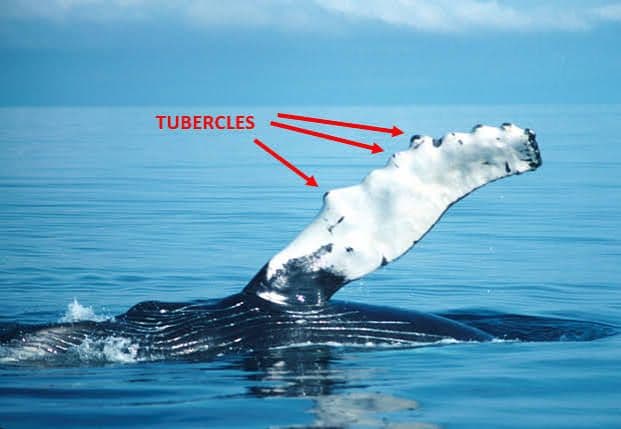
Humpback whales weigh up to 36 tonnes but can perform amazing acrobatic manoeuvres at speeds of around 25km/hr as they breach.
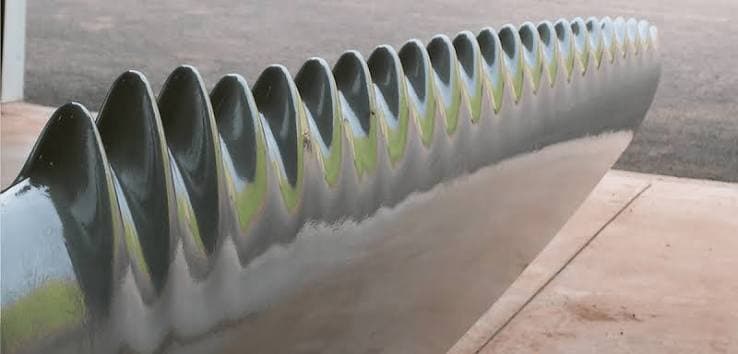
The reason that they can do this is their tubercles - small bumps on the leading edge of their flippers. Tubercles mean that water passing between the bumps forms pairs of spinning vortices that keep the flow attached to the flipper. On a smooth flipper the flow would peel away at steep angles, which is what we call stall. Stall causes a sudden loss of lift and increases in drag. The tubercles give the whale a 40% greater angle of attack before stalling, which is what allows its dramatic manoeuvres.
Marine biologist Frank Fish and engineer Philip Waters modelled the aerodynamic effect of adding small bumps to the leading edge of aerofoils, mirroring tubercles. They found they had a similar effect on small turbine blades, allowing them to work at steeper angles and to stall gently instead of suddenly. At wind speeds above 10 m/s, tubercles on turbine blades have been shown to reduce stall, improving efficiency by around 20% while reducing material wear and extending blade life. The company Whale Power has successfully commercialised this technology on fans and small wind turbines.
Modern turbines don't have a stall problem, because their control systems keep the blades angled safely below it. However, tubercles could still provide more efficient turbine design, changing design constraints. They could allow the blade to work at a steeper angle before it stalls, and stall gently rather than suddenly while keeping the same safety margins.
Fish schools for increasing energy per square metre in wind farms
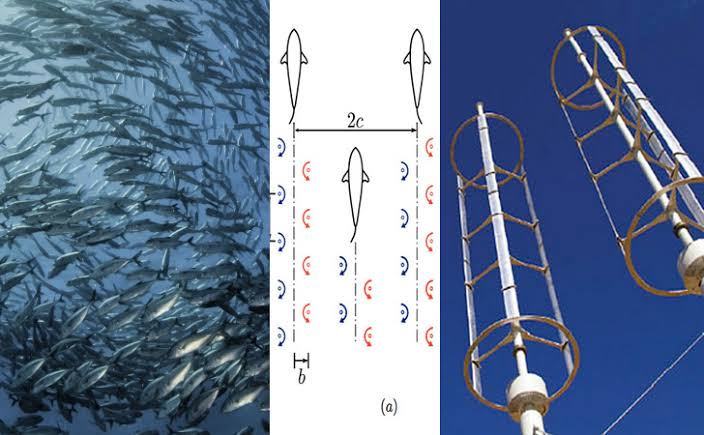
Fish in a school swim more efficiently by benefiting from the wakes around them. Each fish positions itself to push off its neighbours’ trailing vortex, so the whole group moves with less effort and greater efficiency.
A team of engineers led by John Dabiri at Caltech looked closely at this. They found two important patterns:
- Neighbouring vortices spin in opposite directions
- Fish sit in a staggered arrangement rather than a neat grid.
A goal in the offshore wind industry is producing the most energy per square metre. There are limitations in the space available for fixed wind farms and minimising areas of wind farms is desirable because it reduces disturbance to the seabeds and marine life. Conventional horizontal-axis turbines must be spaced far apart because interacting wakes disturb each other and reduce energy efficiency.
Vertical-axis turbines however shed vortices in the same patterns fish do. Dabiri trialled packing 24 vertical-axis turbines close together, in the counter-rotating fish-school pattern. He found that, similarly to fish schools, this pattern allowed turbines to be close together – benefiting from neighbouring wakes instead of disturbing them.
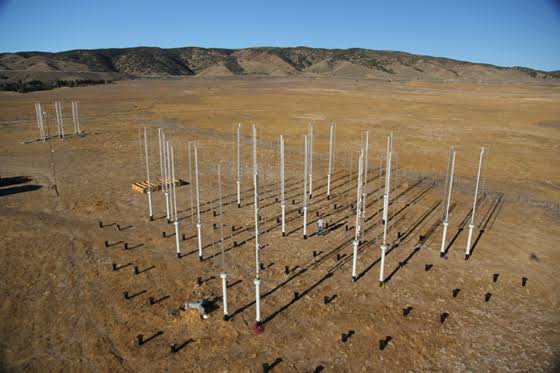
Vertical-axis turbines alone are much less energy efficient than commercial horizontal turbines - however in this pattern they were found to produce 10 times the power per square metre of a conventional farm where turbines are so spread out.
Artificial reefs to support marine life and prevent erosion
Natural reefs support approximately 32% of marine life. Reefs are structures with cracks and holes allowing small marine life shelter and feeding grounds and drawing in larger animals creating biodiverse environments. Reefs also act as natural breakwaters, with waves breaking on reefs, absorbing energy therefore protecting the coastlines behind from erosion.
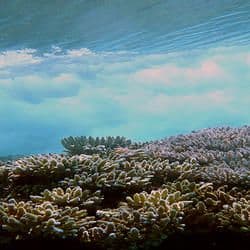
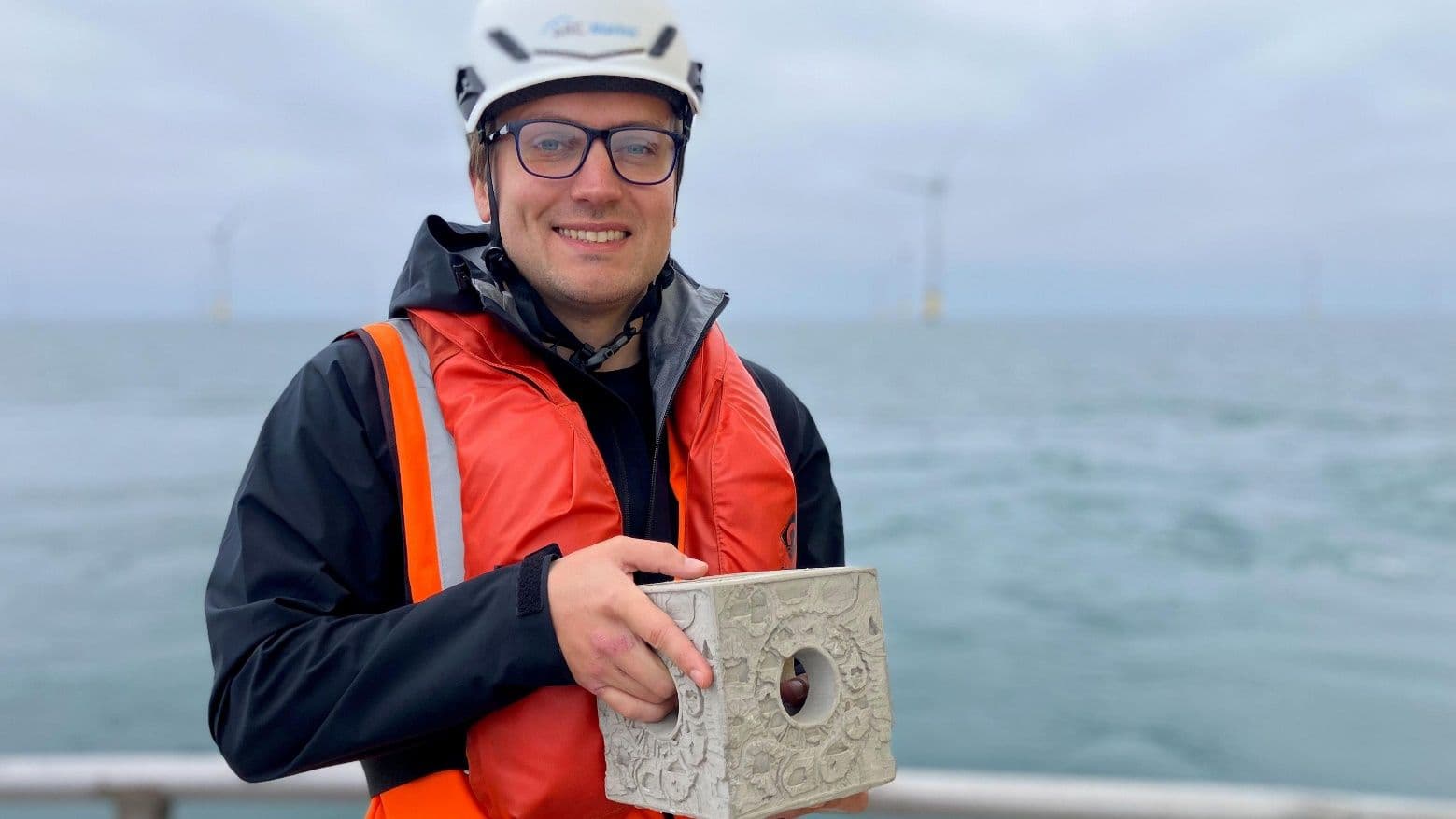
The same principle can be applied to offshore wind foundations. Turbine foundations and rock scour protection around them have been found by North Sea studies to act as accidental reefs supporting marine life. Inspired by this, holey low carbon concrete cubes are being trialled at wind turbine foundations to create artificial reefs. These artificial reefs will support marine life while absorbing wave energy to prevent erosion and increase the lifetime of the foundations.
Takeaways
Despite these examples not being in commercial use yet they act as a reminder that there is lots of research and innovation happening in offshore wind and how exciting it is to be working in such a new industry. Biomimicry is specifically exciting in this context as it is cool to be able to take inspiration from the things that renewable energy is here to protect!
Category:
Blog
Written by:

Miriam Chedgzoy